From Spreadsheet Chaos to Creator CRM: How Agencies Manage Hundreds of Influencers
Date Published
May 26, 2026
Written by
Michael Gratteri
Time to Read
5 min
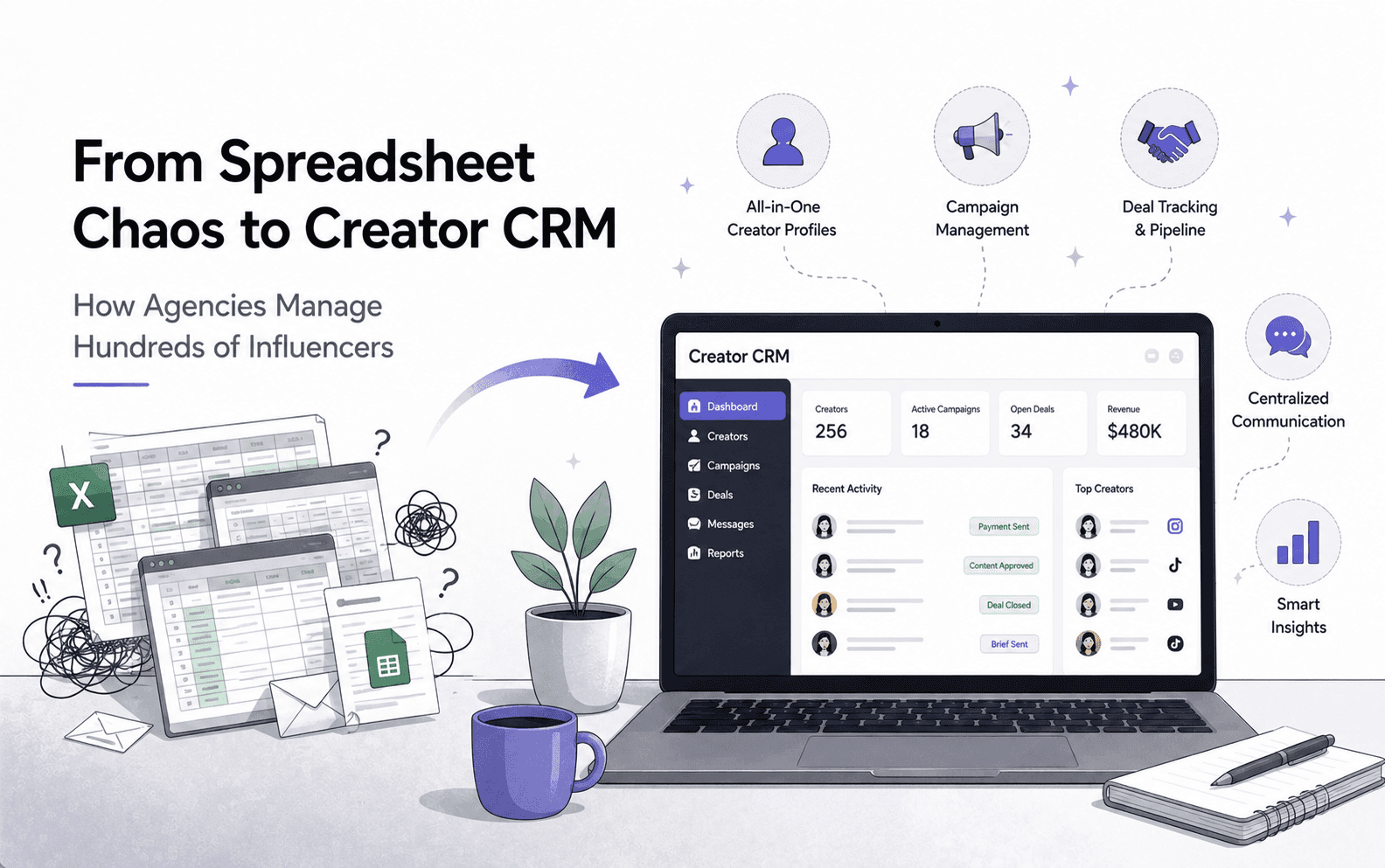
Most creator agencies don't start with sophisticated software.
They start with spreadsheets.
A few creators are easy to manage using Excel sheets, Google Sheets, email folders, and maybe a project management tool. When an agency represents five or ten creators, this approach often works well enough.
The problem begins when growth arrives.
Twenty creators become fifty.
Fifty become one hundred.
Campaigns multiply. Brand relationships expand. Deal pipelines become more complex.
What once felt organized quickly turns into operational chaos.
This is the point where many agencies realize they don't have a talent problem. They have a systems problem.
The Early Days: Why Spreadsheets Seem Good Enough
Almost every creator agency begins here.
A spreadsheet tracks:
Creator names
Social channels
Contact information
Rates
Brand partnerships
Campaign status
It feels simple and cost-effective.
At this stage, spreadsheets solve more problems than they create.
However, spreadsheets were never designed to serve as a long-term influencer management system.
As agencies scale, cracks begin to appear.
The Hidden Costs of Spreadsheet-Based Management
The biggest challenge isn't data storage.
It's data fragmentation.
Important information becomes scattered across:
Google Sheets
Email threads
Slack messages
Shared drives
Individual team members' notes
When a team member needs information, they often spend more time searching than acting.
Questions become surprisingly difficult to answer:
Which deals are awaiting approval?
Which creators are available for a campaign?
What rate was negotiated last quarter?
Which brand conversations have gone silent?
What campaigns are approaching deadlines?
The information exists somewhere.
The challenge is finding it.
Stage One: Spreadsheet Chaos
Most growing agencies eventually encounter several recurring problems.
Information Lives Everywhere
Creator details are stored in one sheet.
Campaign updates are stored in another.
Brand communications are buried in email inboxes.
Nobody has a complete view of the relationship.
Reporting Becomes Difficult
As creator rosters grow, generating accurate reports requires increasingly manual work.
Simple updates can take hours.
Collaboration Slows Down
New team members struggle to understand existing workflows.
Institutional knowledge becomes dependent on specific employees rather than systems.
Opportunities Get Missed
A forgotten email.
An untracked follow-up.
A delayed approval.
Small mistakes can result in lost revenue and damaged relationships.
This is often when agencies start looking for CRM solutions.
Stage Two: Moving to Traditional CRM Tools
The next step for many agencies is adopting a generic CRM.
This creates immediate improvements.
Teams gain:
Better contact management
Deal tracking
Activity histories
Workflow visibility
For some agencies, this is enough.
But creator businesses are fundamentally different from traditional sales organizations.
A standard CRM was designed to manage customers.
Creator agencies need to manage creators, campaigns, partnerships, deliverables, contracts, payments, and brand relationships simultaneously.
Eventually, limitations begin to emerge.
Why Generic CRMs Fall Short
Traditional CRM systems are excellent for sales teams.
They are less effective for content creator management.
Creator agencies need visibility into:
Creator profiles
Audience demographics
Brand fit
Campaign deliverables
Content approvals
Sponsorship timelines
Partnership history
These requirements often require extensive customization within generic CRM platforms.
As complexity increases, agencies begin searching for systems designed specifically for creator operations.
Stage Three: Dedicated Creator Management Platforms
This is where agencies begin transforming operations.
A dedicated creator management platform centralizes information that was previously scattered across multiple systems.
Instead of managing creators through disconnected spreadsheets and inboxes, agencies gain a unified operational environment.
Everything becomes easier to access, track, and manage.
Creator Profiles in One Place
Teams can quickly access:
Creator information
Platform metrics
Audience insights
Partnership history
Contact records
Instead of searching across multiple documents, information becomes immediately available.
Better Relationship Management
One of the biggest advantages of a modern influencer relationship management software solution is visibility.
Every interaction becomes part of a unified relationship history.
This helps agencies provide better service to both creators and brands.
Improved Campaign Execution
Campaign management becomes significantly easier when all stakeholders are working from the same source of truth.
Many agencies are now combining creator management systems with dedicated influencer campaign management workflows to improve visibility across deliverables, approvals, and campaign progress.
Centralized Communication
Managing creator emails becomes increasingly difficult as agencies scale.
Instead of relying solely on individual inboxes, agencies are implementing centralized influencer email management processes that help teams collaborate more effectively and prevent important conversations from getting lost.
The Shift From Data Storage to Operational Intelligence
The most advanced agencies are no longer focused solely on organizing information.
They're focused on using information more effectively.
A modern influencer management platform does more than store data.
It helps teams:
Identify opportunities faster
Track deal progress
Improve campaign coordination
Reduce administrative work
Increase operational visibility
The result is not just better organization.
It's better decision-making.
Scaling From 20 Creators to 200 Creators
The systems that work for a 20-creator agency rarely work for a 200-creator agency.
At larger scales, operational efficiency becomes a competitive advantage.
Agencies that continue relying on spreadsheets often experience:
Slower execution
More manual work
Reduced visibility
Increased risk of errors
Agencies that invest in purpose-built systems can manage larger creator rosters without proportionally increasing operational complexity.
This is one reason why many talent managers are exploring how agencies can scale influencer campaigns without continuously hiring more people.
The Future of Creator Operations
The creator economy is becoming more sophisticated every year.
Brands expect faster communication.
Creators expect better support.
Campaigns involve more moving parts than ever before.
The agencies that thrive in this environment are increasingly adopting technology that supports every stage of creator operations.
From relationship management to campaign execution, modern creator agencies need systems built specifically for the creator economy.
Many are now combining creator management platforms with creator deal tracking portals to maintain visibility across partnerships, negotiations, deliverables, and revenue opportunities.
As automation and AI continue evolving, this trend will only accelerate.
Final Thoughts
Spreadsheets aren't the enemy.
In fact, they're often the right starting point.
But eventually every growing agency reaches a crossroads.
Continue adding more sheets, more tabs, and more manual processes.
Or build a system designed to scale.
The most successful agencies understand that growth is not just about acquiring more creators.
It's about creating operational systems that allow teams to support those creators effectively.
If your agency is struggling with fragmented information, missed follow-ups, and operational bottlenecks, it may be time to move beyond spreadsheets and explore a dedicated influencer management platform built for the realities of modern creator management.