How AI Assistants Are Transforming Creator Agency Operations in 2026
Date Published
May 18, 2026
Written by
Productivity
Time to Read
5 min
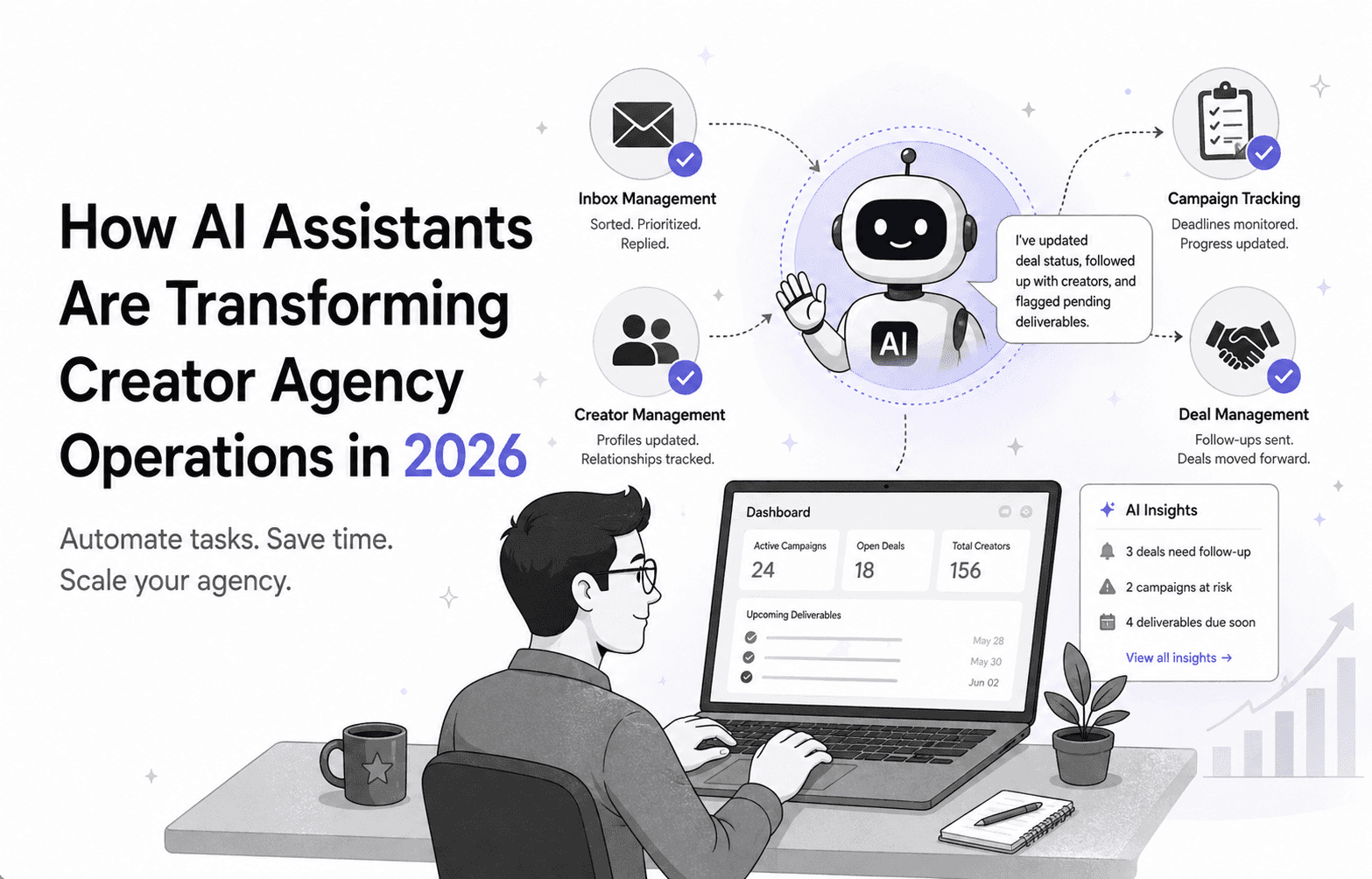
The creator economy has matured.
What started as a handful of influencers managing brand deals through email has evolved into a complex ecosystem involving agencies, talent managers, creators, brands, legal teams, and campaign coordinators.
As agencies grow, so does operational complexity.
More creators mean more emails. More campaigns mean more deadlines. More partnerships mean more contracts, negotiations, reporting, and payment tracking.
For many creator agencies, the biggest challenge in 2026 isn't finding creators or securing brand deals.
It's managing the growing volume of operational work that comes with success.
This is where AI assistants are beginning to change the way agencies operate.
The Real Problem Isn't Campaign Management
Most creator agencies already have talented people.
They know how to negotiate partnerships, build creator relationships, and execute successful campaigns.
The challenge is that their teams spend a significant amount of time on repetitive administrative work.
Consider a typical day for a talent manager:
Checking dozens of emails
Following up with brands
Tracking campaign deliverables
Updating creator records
Monitoring deal progress
Coordinating internal teams
Preparing reports
None of these activities directly generate revenue.
Yet they consume a large portion of the workday.
As agencies scale, these manual tasks often become operational bottlenecks.
Why Hiring More People Isn't Always the Answer
The traditional solution has been straightforward: hire more account managers.
But that approach creates its own challenges.
More people mean:
Higher operational costs
More internal communication
Increased training requirements
Greater management overhead
Many agencies eventually discover that adding headcount does not automatically improve efficiency.
In fact, complexity often grows faster than productivity.
This is one reason why forward-thinking agencies are investing in AI for creator management rather than relying solely on larger teams.
What AI Assistants Actually Do
There is often confusion around AI in the creator industry.
Many people imagine fully autonomous systems replacing human managers.
That isn't what's happening.
The most valuable AI assistants function as operational partners.
They help teams organize information, surface insights, automate repetitive tasks, and reduce administrative workload.
Instead of replacing talent managers, they allow talent managers to focus on higher-value activities.
AI Is Becoming the Operational Layer of Modern Agencies
In 2026, creator agencies are increasingly using AI to support:
Email Monitoring and Organization
Brand opportunities often arrive through multiple communication channels.
Important conversations can easily become buried beneath hundreds of emails.
AI-powered systems help agencies prioritize conversations, identify partnership opportunities, and manage influencer emails more efficiently.
This is especially valuable for agencies handling dozens or hundreds of creators simultaneously.
Deal Tracking
One of the biggest operational risks for agencies is losing visibility into active opportunities.
Without a centralized system, teams often rely on spreadsheets, Slack messages, and email threads to understand deal status.
AI assistants can help track conversations, identify stalled negotiations, and maintain visibility throughout the deal lifecycle.
Campaign Coordination
Managing deliverables across multiple creators can become difficult as campaign volume increases.
AI-supported workflows help teams monitor deadlines, track progress, and reduce the likelihood of missed commitments.
Many agencies are now combining AI tools with dedicated influencer campaign management platforms to improve campaign execution and operational oversight.
Knowledge Retrieval
Agency teams often spend time searching for information.
Questions such as:
Has this creator worked with this brand before?
What rate was negotiated last year?
What stage is this deal currently in?
An AI assistant can help surface information instantly, reducing internal friction and improving decision-making speed.
The Shift From Reactive to Proactive Management
One of the most significant advantages of AI is its ability to help agencies become proactive.
Traditional workflows are often reactive.
Managers respond to emails.
They chase updates.
They discover issues after problems occur.
AI changes this dynamic.
Modern AI assistants can identify potential delays, highlight inactive deals, and surface important information before it becomes a problem.
This allows agencies to spend less time firefighting and more time building creator relationships.
Why Creator Agencies Need Specialized AI
General-purpose AI tools can help with writing and research.
However, creator agencies have unique workflows.
They manage:
Brand partnerships
Creator profiles
Campaign deliverables
Deal pipelines
Contract workflows
Revenue tracking
A specialized AI tool for creator agencies understands these operational requirements and works within the context of creator management.
This is where dedicated solutions provide greater value than generic AI assistants.
The Rise of AI-Powered Deal Management
Deal execution remains one of the most time-consuming aspects of creator operations.
Every partnership involves multiple moving parts:
Discovery
Outreach
Negotiation
Approval
Content delivery
Reporting
Payment
When agencies manage dozens of campaigns simultaneously, maintaining visibility becomes increasingly difficult.
Many agencies are now using AI assistant for deal management solutions to streamline these processes and reduce manual coordination.
The result is faster execution, improved accountability, and fewer missed opportunities.
Human Relationships Still Matter Most
Despite the rapid growth of AI, creator management remains a relationship-driven business.
Brands partner with people.
Creators trust people.
Negotiations succeed because of people.
AI cannot replace trust, creativity, strategic thinking, or relationship building.
What it can do is eliminate repetitive operational work that prevents managers from focusing on those activities.
The agencies gaining the greatest advantage from AI are not replacing their teams.
They are empowering them.
What the Future Looks Like
Over the next few years, the most successful agencies are likely to operate differently than they do today.
Instead of hiring larger administrative teams, they will use AI to support operations across:
Creator onboarding
Opportunity tracking
Email management
Campaign execution
Deal monitoring
Performance reporting
This shift will allow agencies to manage more creators, execute more campaigns, and improve client service without proportional increases in overhead.
Final Thoughts
The creator economy is becoming more competitive every year.
Agencies that continue relying entirely on manual processes may find it increasingly difficult to scale efficiently.
AI is no longer simply a productivity tool.
It is becoming a core operational advantage.
The goal is not to replace talent managers or creator relationships.
The goal is to remove the repetitive work that slows teams down.
As agencies continue to grow, the winners will be those that successfully combine human expertise with intelligent operational support.
If you're looking for an AI assistant for creator management that helps streamline agency operations, organize deal workflows, and improve visibility across creator partnerships, explore Stella AI Assistant by Creator24 and discover how AI for influencer management is reshaping the future of creator agencies.