Why Talent Agencies Don’t Have a CRM Problem—They Have a Deal Execution Problem
Date Published
Apr 8, 2026
Written by
Michael Gratteri
Time to Read
5 min
creator management software, talent agency CRM, deal management for creators, influencer deal pipeline
Most talent agencies think they need a better CRM.
They don’t.
They need a system that actually executes deals.
Traditional CRMs were built for sales teams managing contacts and pipelines. But talent managers don’t operate like sales reps. Their workflow is nonlinear, fragmented, and deeply tied to real-time communication.
Deals don’t start in a CRM. They start in outbound messages, DMs, or emails. They evolve through conversations. And they close through execution — contracts, invoices, and payments.
This is where most systems fail.
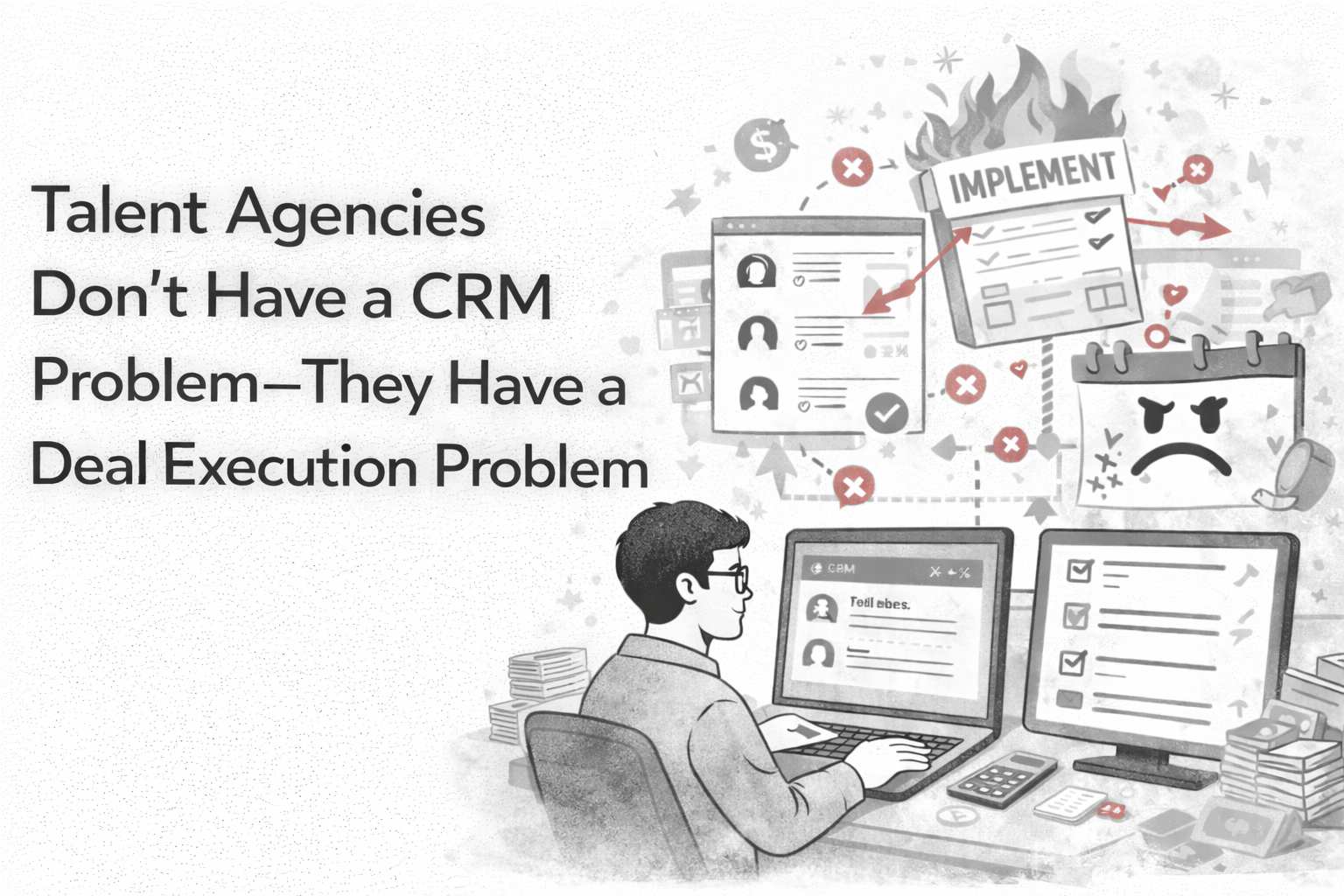
The Real Problem: Context Fragmentation
Talent managers operate across:
Gmail threads
WhatsApp messages
Spreadsheets
Media kits
Internal notes
Each deal is cattered across tools. There is no single source of truth.
As deal volume increases:
Follow-ups slip
Context is lost
Revenue leaks
The issue isn’t tracking deals — it’s executing them with full context.
What a “Deal Execution System” Actually Looks Like
A true deal execution system is built around one principle:
The deal is the system of record.
This means:
Emails automatically attach to deals
Pitches create deals instantly
Contracts are generated from agreed terms
Invoices reflect deal status in real time
Nothing is duplicated. Nothing is re-entered.
The system doesn’t ask for updates — it builds itself from activity.
Why CRMs Break at Scale
CRMs require manual upkeep:
Updating stages
Logging notes
Creating tasks
At low volume, this works. At scale, it collapses.
Managers stop updating the system. The system becomes unreliable.
And when the system isn’t trusted — it stops being used.
The Shift That Changes Everything
When deal execution is automated:
Pipelines update themselves
Context is never lost
Deals move faster
Managers focus on closing, not admin
The pipeline becomes a mirror of reality, not a guessed representation.
Practical Takeaway
If your team is:
Constantly checking email for “real” deal status
Forgetting follow-ups
Rebuilding context on every reply
You don’t have a CRM problem.
You have an execution problem.